Nail-file grit: what the number actually describes
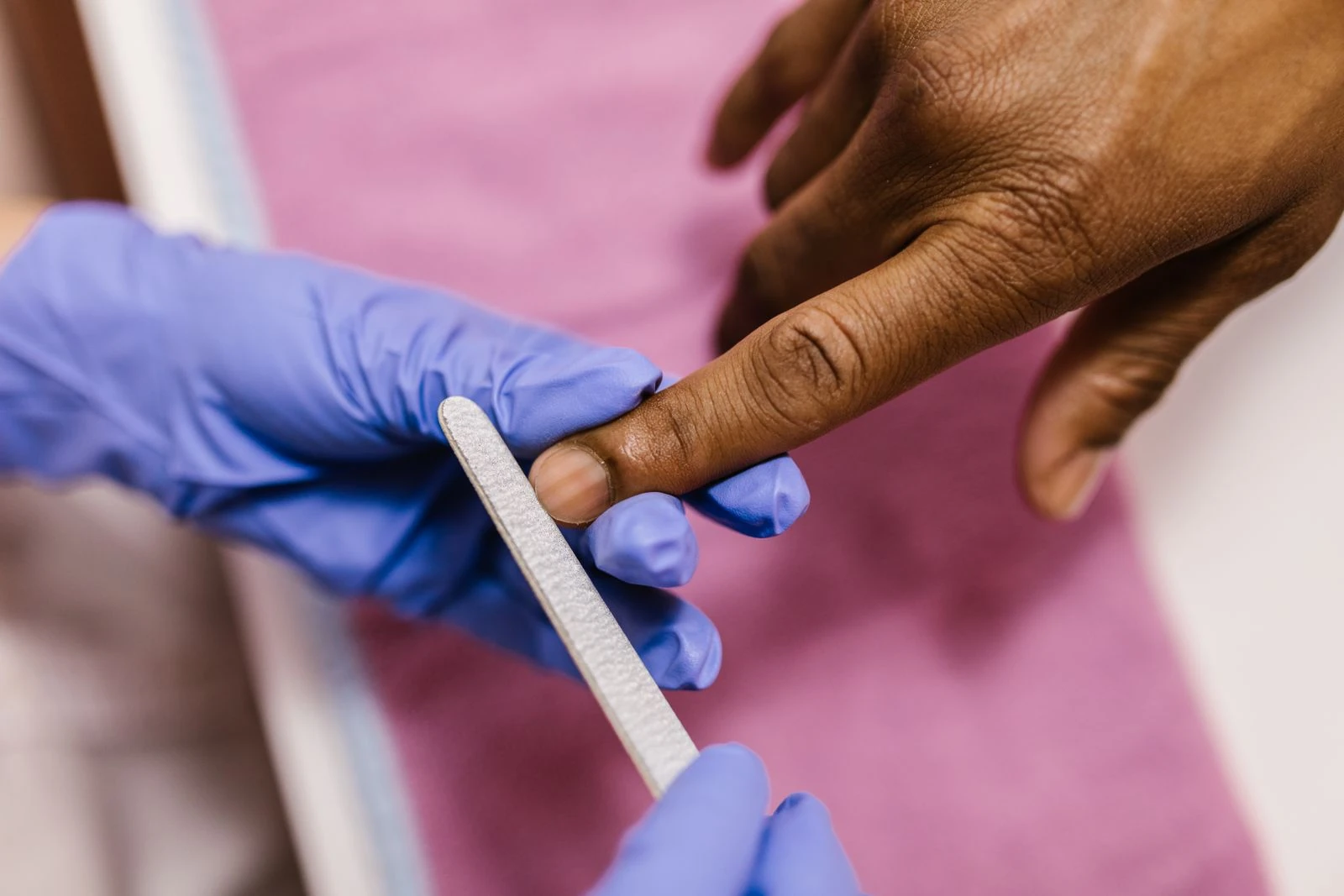
Grit describes an abrasive’s particle-size grade. Within the same grading system, a higher number generally indicates a finer abrasive. The number is one part of a file’s specification; it is not a universal measure of pressure, material removal or suitability for every nail surface. [1][2]
KEY TAKEAWAYS
P and F are different grading systems
FEPA uses P-grades for coated abrasives, where grains are carried on a backing, and F-grades for bonded abrasives. A grade describes a particle-size distribution, not one identical diameter for every grain. Keep the prefix when reading a specification: P220 and F220 are not interchangeable labels merely because their numbers match. [1]
Real designation examples
FEPA’s public catalogue lists P12–P220 and P240–P5000 for coated abrasives, and F4–F220 and F230–F2000 for bonded abrasives. P220 and P240 thus name real grades within the P series; the higher P number indicates a finer grade. A bare “220” on a nail file does not establish which series its supplier uses. These examples decode grade names; they do not select a file for a nail surface. [2][3]
Compare the complete specification
Norton Abrasives’ supplier guide describes grain type and backing as well as grit number. It concerns general abrasives, including sandpaper for wood, rather than a nail-filing protocol. Our reading: use it to understand the specification fields, without treating it as a test of a particular nail file. [2]
Article Sources
- FEPA — Abrasive grains and grit sizes
Primary source
Passages on F-grit for bonded abrasives and P-grit for coated abrasives: separate grading systems and particle-size distributions/ranges.
- Norton Abrasives — Choosing the Right Sandpaper
Manufacturer material
Passages on grade, abrasive grain and backing. Used for general abrasive terminology; woodworking procedures are not transferred to nails.
Article date:
- FEPA — Grains: F and P abrasive standards
Primary source
Standards catalogue entries name F4–F220 and F230–F2000 for bonded abrasives, and P12–P220 and P240–P5000 for coated abrasives. The public list supplies real designations; paid standards and numerical particle-size tables were not examined.
Written and reviewed with AI assistance using the linked sources. No hands-on product testing or independent specialist review was performed.
Commercial resource from our ecosystem
BELOM develops equipment for nail professionals. Brand information is available on the official BELOM website. A commercial brand link is separate from the sources supporting this article.
Professional nail materials and tools with NailMarket.eu — a shop in our ecosystem.
NailWiki, BELOM, NailMarket, BELOM App and NaNails are projects of BELOM Group OÜ, as identified by the owner. Molokom catalogue images are supplied through our NaNails shop; this commercial relationship is not independent product-test evidence.