Nail lamps: power, wavelength and system compatibility
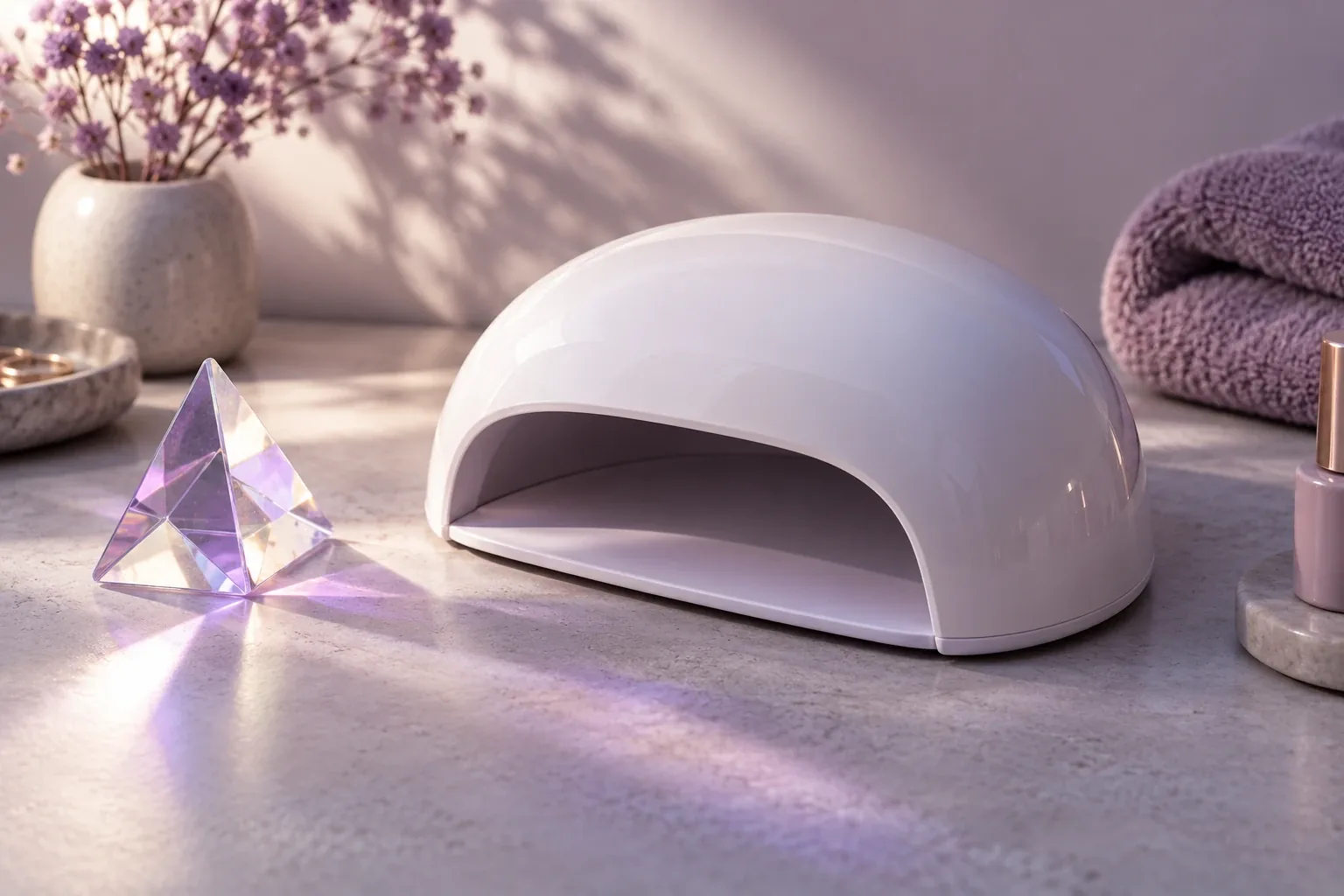
Electrical input power does not describe the spectrum or the light reaching a coating. A useful lamp specification separates electrical, optical and system-compatibility information. The wavelength matters because a photoinitiator responds to particular parts of that spectrum, as NailKnowledge’s professional-education material explains. [1][2]
KEY TAKEAWAYS
W, W/m² and nm describe different quantities
NIST lists the watt (W) as the unit of power and W/m² as the unit of irradiance. Wavelength is a length, commonly expressed here in nanometres: 1 nm = 10⁻⁹ m. Electrical input power concerns energy supplied per time; irradiance concerns incident radiant power per area at a specified position; wavelength describes the light. The unit and quantity name must stay together. [1][4]
Why 365 nm and 405 nm appear in light-response comparisons
WHO defines UVA as 315–400 nm, placing 365 nm within UVA. 405 nm lies within NASA’s visible-light range. These numbers identify different spectral regions, not two equivalent power settings. [3][4]
The photoinitiator provides the chemical connection: BASF’s supplier table lists Irgacure 819 absorption peaks at 360, 365 and 405 nm. NailKnowledge explains that initiators are activated by particular wavelengths. The example shows why spectral overlap matters; it does not supply a curing dose, establish an EU cosmetic permission or validate a lamp for every nail formula. [2][5]
The manufacturer’s named system
CND’s Visible Light Lamp page states compatibility with CND’s own light-curable systems. This is the manufacturer’s stated scope, not an independent test or permission to extend the claim to other brands. It supplies the product-system identity that a watt figure alone cannot name. [6]
How we interpret an incomplete specification
Our reading: do not turn a wavelength label or visible firmness into a verified curing result. Keep the identified formula, lamp and validated instructions together. This article explains the fields; it does not create exposure times, layer thicknesses or a replacement for the manufacturer’s procedure.
Article Sources
- National Institute of Standards and Technology (NIST) — NIST Guide to the SI, Chapter 4: The Two Classes of SI Units and the SI Prefixes
Primary source
Chapter 4: Table 3 defines power and radiant flux in W = J/s; Table 4 gives irradiance in W/m²; Table 5 gives the nano prefix as 10⁻⁹. Unit definitions, not lamp-performance data.
Webpage updated:
- NailKnowledge — UV Gel Explained, English v6
Industry educational material
Printed pages 11–12: monomers, oligomers and polymer chains; 13–15: initiation and wavelength-dependent photoactivation; 27–29: hardening versus conversion and unreacted components. Professional education used for qualitative mechanisms only; numerical cure thresholds, catalyst generalisations and clinical or operating advice are excluded. Printed and one-based PDF page numbers match.
- World Health Organization — Radiation: Ultraviolet (UV) radiation
Primary source
UV bands definition: UVA 315–400 nm; wavelength classification only, no manicure-specific risk or exposure limit extrapolation.
Article date:
- NASA — Spectroscopy 101 – Light and Matter
Primary source
Waves: wavelength is the distance between successive peaks. The “The Electromagnetic Spectrum” infographic and its accessible description in Light give visible light as 380–780 nm and distinguish it from UV.
Webpage updated:
- BASF — Protecting what’s around us — Resins and additives for furniture and floor coatings
Manufacturer material
PDF page 23 (printed spread 44–45): Irgacure® TPO, Irgacure® TPO-L and Irgacure® 819 rows, chemical-name and UV/VIS absorption-peaks columns. Historical industrial supplier data, not cosmetic permission or a validated curing schedule for a finished gel/lamp system.
- CND — CND Visible Light Lamp
Manufacturer material
Product description: the compatibility statement covers CND’s own light-curable systems. A manufacturer statement for the named system, not independent validation or a cross-brand compatibility statement.
Written and reviewed with AI assistance using the linked sources. No hands-on product testing or independent specialist review was performed.
Commercial resource from our ecosystem
BELOM develops equipment for nail professionals. Brand information is available on the official BELOM website. A commercial brand link is separate from the sources supporting this article.
Professional nail materials and tools with NailMarket.eu — a shop in our ecosystem.
NailWiki, BELOM, NailMarket, BELOM App and NaNails are projects of BELOM Group OÜ, as identified by the owner. Molokom catalogue images are supplied through our NaNails shop; this commercial relationship is not independent product-test evidence.