Polymer chains and crosslinks: two different structures
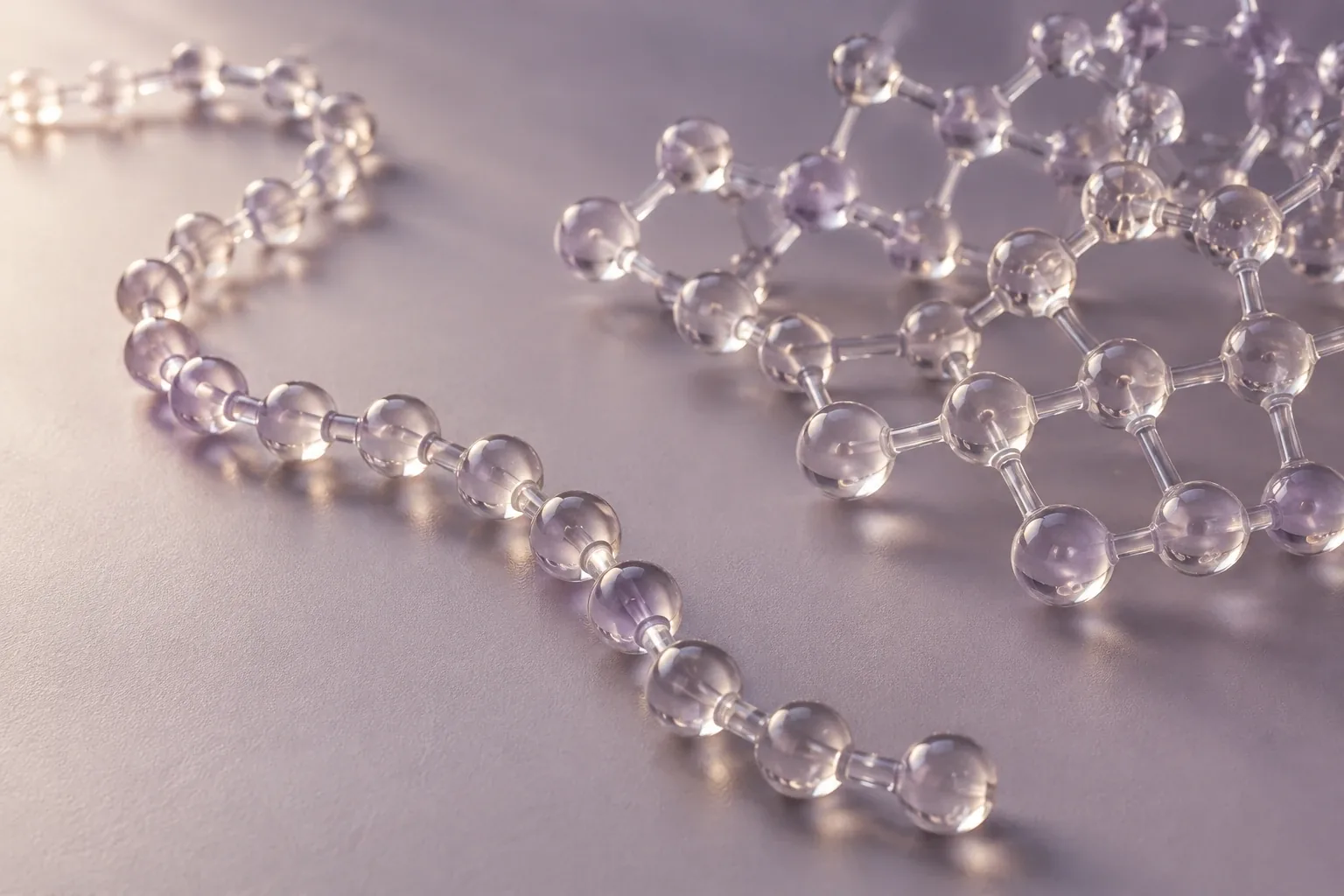
A polymer chain joins molecular building units in a sequence. Crosslinks connect chains into a network. UNSW’s materials tutorial describes thermoset networks linked by covalent crosslinks. Our reading: a longer chain and a more connected network describe different structures. [1][2]
KEY TAKEAWAYS
Chain length and molecular mass
UNSW explains that an increase in average polymer molecular mass corresponds to an increase in average chain length. NailKnowledge’s professional-education glossary describes oligomers as relatively short linked monomer chains. Neither source supplies one chain-length threshold that separates every nail gel into a performance category. [2][3]
What crosslinks change
UNSW contrasts thermoplastic chains, which can move relative to each other when heated, with thermoset networks held together by covalent crosslinks. These connections constrain chain movement; the thermoset cannot simply be melted again. In its elastomer example, occasional crosslinks help the material return to its original shape after deformation. These are general materials examples, not a classification or measured hardness result for a particular nail gel. [1]
Can a network description supply a hardness result?
Our reading: A coating description may mention polymerisation, chain structure and crosslinking. Those words establish different concepts, but they do not supply a measured hardness, fracture resistance or wear result. Claims about a finished formula need evidence for that formula and its conditions; counting structural labels is not a performance comparison.
Article Sources
- UNSW School of Materials Science and Engineering — Polymer types
Educational reference material
Thermosets and Elastomers sections: covalent bonds between chains and occasional crosslinks. General polymer education, without ranking nail products.
- UNSW School of Materials Science and Engineering — Molecular mass and plasticisers
Educational reference material
Molecular mass and Plasticisers sections: average molecular mass and chain length; free volume, chain motion and Tg in the PVC example.
- NailKnowledge — Oligomers
Industry educational material
Glossary definition: short chains of monomers as building blocks for polymers.
Written and reviewed with AI assistance using the linked sources. No hands-on product testing or independent specialist review was performed.