Holographic polish: linear and scattered effects explained
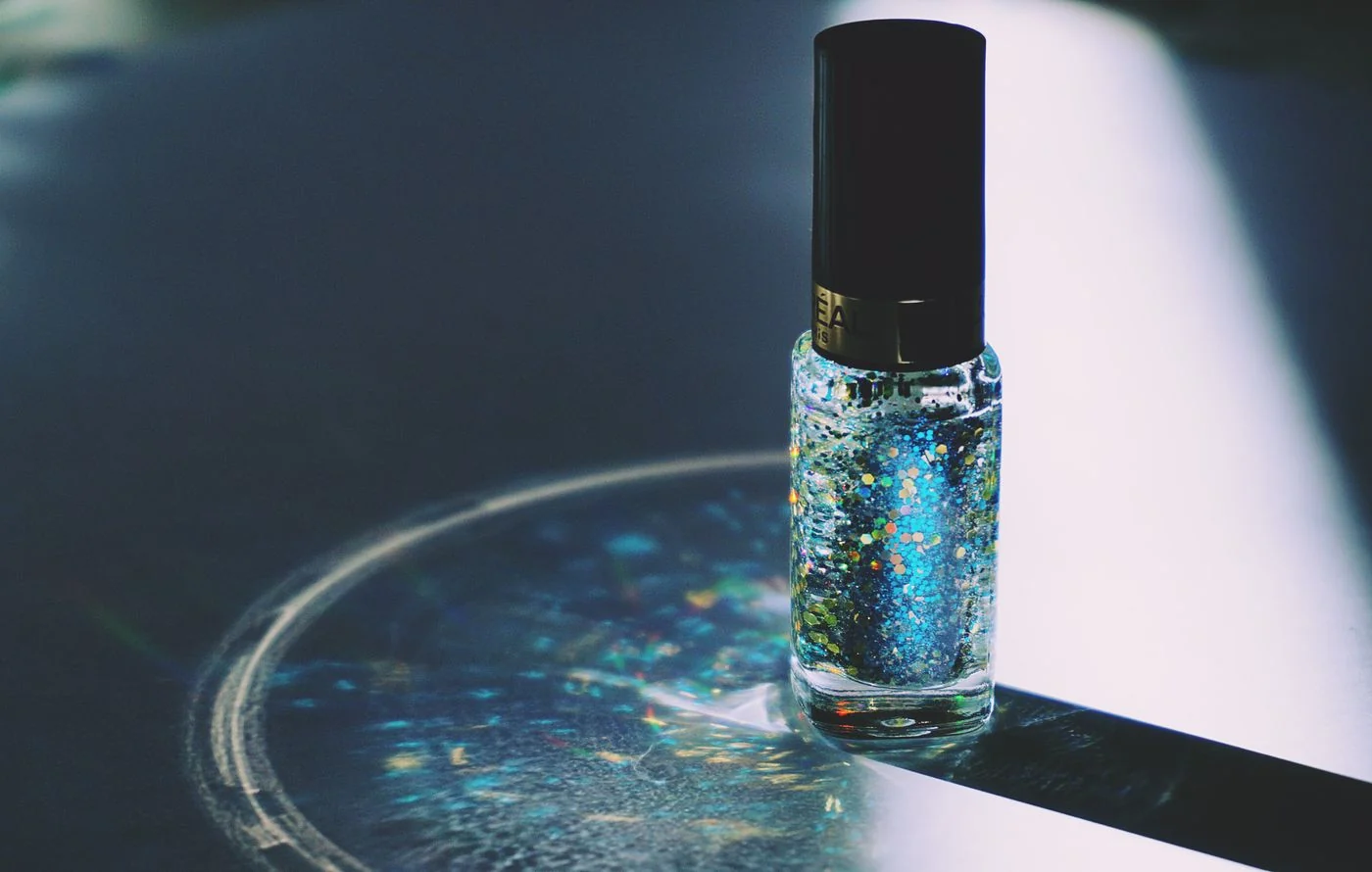
Holographic polish uses diffractive particles to make a rainbow effect. Different wavelengths leave at different angles. Linear holo shows a smoother sweep of colour; scattered holo breaks it into flashes. Particle size, density, formula and application all affect that appearance. These are informal finish terms: one ILNP page uses both for the same polish. [1][2][3]
KEY TAKEAWAYS
- Diffraction separates white light into a spectrum. A grating has a regular pattern of slits or reflecting grooves. Different wavelengths appear at different angles. [1][2][4]
- A smooth particle layer gives a gradual colour sweep, called linear holo. A less smooth layer gives a more scattered effect. Lab Muffin says size, density, formula and application all matter. [1]
- Holographic effects look strongest in direct, directional light: a pigment article describes bright silver under diffuse light and strong rainbow effects under direct illumination. [3][4]
- ILNP’s labels show how the terms get mixed: one polish is titled Linear+Scattered while its Holo Finish field reads Scattered, and the page defines neither word. [3]
How holographic polish splits light
Lab Muffin describes silver-coloured particles that split white light into a spectrum. The guide calls its diagram simplified: the effect involves constructive and destructive interference. A diffraction grating explains the regular surface pattern behind that splitting. The textbook and pigment references below supply that detail. [1]
OpenStax defines a diffraction grating as many evenly spaced parallel slits. Gratings can transmit or reflect light. With white light, its diagram shows a white central maximum and rainbow-coloured higher orders. For perpendicular incident light, the condition is d sin θ = mλ. Here d is slit spacing, θ is the angle, m the order and λ the wavelength. [2]
The angle therefore depends on the wavelength. OpenStax’s worked example finds different first-order angles for the shortest and longest visible wavelengths. Changing the viewing angle or light direction changes which colour reaches the eye. A CD provides a familiar reflecting-grating example. [2]
PCI Magazine’s 2004 technical report describes vacuum-deposited pigments made on a patterned surface. The reflecting surface has regular grooves at uniform depths. This creates diffractive effects rather than relying on thin-film interference alone. VIAVI describes its SpectraFlair flakes as opaque and mirror-like because they have an aluminium core. Their surface texture can give silver or rainbow effects. That data sheet concerns paints, coatings and plastics, not a nail-polish formula. [4][5]
What linear and scattered describe
Lab Muffin links the two looks to the smoothness of the particle layer. A smooth layer gives a gradual sweep through the spectrum: linear holo. An uneven layer breaks up that colour change: scattered holo. Smaller particles and a denser polish generally give a smoother layer, according to the guide. A very smooth CD or DVD surface can produce an uninterrupted rainbow. [1]
Formula and application matter too. Lab Muffin’s SpectraFlair-topcoat swatches looked mostly linear with one coat. Three coats looked less linear despite containing more particles. The author attributed this to repeated brushing making the surface uneven. The guide also separates linear and scattered polish from holo glitter, which contains holographic glitter pieces. [1]
| Feature | Linear | Scattered |
|---|---|---|
| Layer [1] | Smooth layer | Less smooth layer |
| Colour change across the nail [1] | Colours go gradually through the spectrum | Colour change is less gradual |
| Particle size and density [1] | Generally, smaller and denser particles give the smoother layer | Less smooth particle layer; size alone does not establish the appearance of every formula |
| Product-page examples [3][6][7] | ILNP MEGA (L) and Aerial View: Holo Finish field set to Linear | ILNP My Private Rainbow: Holo Finish field set to Scattered, although its title reads Linear+Scattered |
Reading a real label: linear, scattered and SpectraFlair
ILNP titles My Private Rainbow Linear+Scattered. Its description says it balances both looks using SpectraFlair 35 and 14 series pigments, presented as two particle sizes. Yet its Holo Finish field reads Scattered. The page does not formally define either term. [3]
VIAVI’s grade table lists 1500-35, 1500-20 and 1500-14. Their median particle sizes, D50, are 33, 20 and 14 micrometres. Both VIAVI and the PCI report describe SpectraFlair as diffractive. That supports the mechanism for the pigment ILNP names, but not for every holo polish. ILNP supplies no exact VIAVI grade code. Its series numbers should not automatically be read as particle diameters. [3][4][5]
ILNP’s MEGA (L) page sets Holo Finish to Linear. The brand says its particles are smaller than those in the original MEGA and give a smoother rainbow in direct light. Aerial View also has a Linear field and a description naming uniform particles. These claims fit Lab Muffin’s explanation, but they remain marketing descriptions rather than measurements. [1][6][7]
Light and what to expect
Directional light makes diffractive rainbows easier to see. ILNP says My Private Rainbow’s SpectraFlair looks silver outside direct sunlight. The PCI report likewise describes silver under diffuse light and strong rainbow effects under direct illumination. [3][4]
A hypothetical example, not an observed result: two holo toppers are listed, one as linear with small, uniform particles and one as scattered with larger, sparser particles. Under a window the first might show smooth rainbow bands sweeping across the nail and the second more broken rainbow flashes, while indoors under diffuse light both might look mostly silver. This follows Lab Muffin’s size explanation and the lighting statements, but no polish was tested for it.
Article Sources
- Lab Muffin Beauty Science (Michelle Wong) - Lab Muffin guide - how do holo nail polishes work?
Expert reference material
Blog post “Lab Muffin guide – how do holo nail polishes work?” (Michelle Wong; 3 January 2012): the holo-types list, the passage on holographic particles splitting or diffracting light with its simplified-diagram note, the passage on particle size, density and smoothness (linear and scattered sentences, CD or DVD sentence), and the swatch series with the closing remark on application and formula. The post does not use the term diffraction grating.
Source date:
- OpenStax, College Physics 2e (Rice University) - 27.4 Multiple Slit Diffraction
Expert reference material
Textbook section “27.4 Multiple Slit Diffraction” in College Physics 2e: Figure 27.16 caption (definition of a diffraction grating, white central maximum, higher orders dispersing white light into a rainbow), the introductory sentence on transmission and reflection gratings, the condition d sin θ = mλ, Example 27.3 (first-order angles for 380 nm and 760 nm) and the Take-Home Experiment “Rainbows on a CD”.
- ILNP - My Private Rainbow (Linear+Scattered)
Commercial source material
Product page “My Private Rainbow (Linear+Scattered)”: description (both linear and scattered reflectance; SpectraFlair 35 and 14 series pigments; the two particle sizes; silver in color when not in direct sunlight) and the product field Holo Finish (Scattered).
- PCI Magazine - Pigments Exhibiting Diffractive Light Interference
Primary source
Article “Pigments Exhibiting Diffractive Light Interference” (PCI Magazine, 1 September 2004; no author byline): the untitled introduction (vacuum deposition on a patterned surface; diffractive instead of thin-film interference gives a new family of effect pigments; SpectraFlair introduced as a diffractive pigment in a May 2002 PCI article), the section “Diffractive Pigment Development” (regularly spaced grooves on a reflective surface; directional illumination) and the section “Morphological Properties” (bright silver under diffuse lighting), as returned by the fetch tool.
Source date:
- VIAVI Solutions - SpectraFlair Light Diffractive Pigments (Data Sheet)
Primary source
Data sheet “SpectraFlair Light Diffractive Pigments”: page 1 (applications in paints, coatings and plastics), page 2 “Color by Physics” (opaque and highly specular because of a center aluminum core layer; surface texture from neutral silver to multi-color rainbow) and page 4 “Physical Properties” table (grades 1500-14, 1500-20 and 1500-35 with D50 of 14, 20 and 33 µm). Printed © 2023 VIAVI Solutions Inc.
- ILNP - MEGA (L): 100% PURE Linear Holographic Nail Polish
Commercial source material
Product page “MEGA (L)” (subtitle “100% PURE Linear Holographic Nail Polish”): description sentences on much smaller holographic pigment particles than the original MEGA and a smoother (“linear”) rainbow in direct light, and the product field Holo Finish: Linear.
- ILNP - Aerial View (Aquamarine Ultra Holographic Nail Polish)
Commercial source material
Product page “Aerial View” (Aquamarine Ultra Holographic Nail Polish): description sentences on linear holographic polish and uniform holographic particle size, and the product field Holo Finish: Linear.
Products and resources
A gel polish category page whose finish filter includes a Holo effect option. The label is the shop’s own and does not say whether any listed product is linear or scattered; no stock or performance is implied. NailMarket gel polish and nail colours
Brand resource only; no technical, launch, testing or certification claim. BELOM equipment project