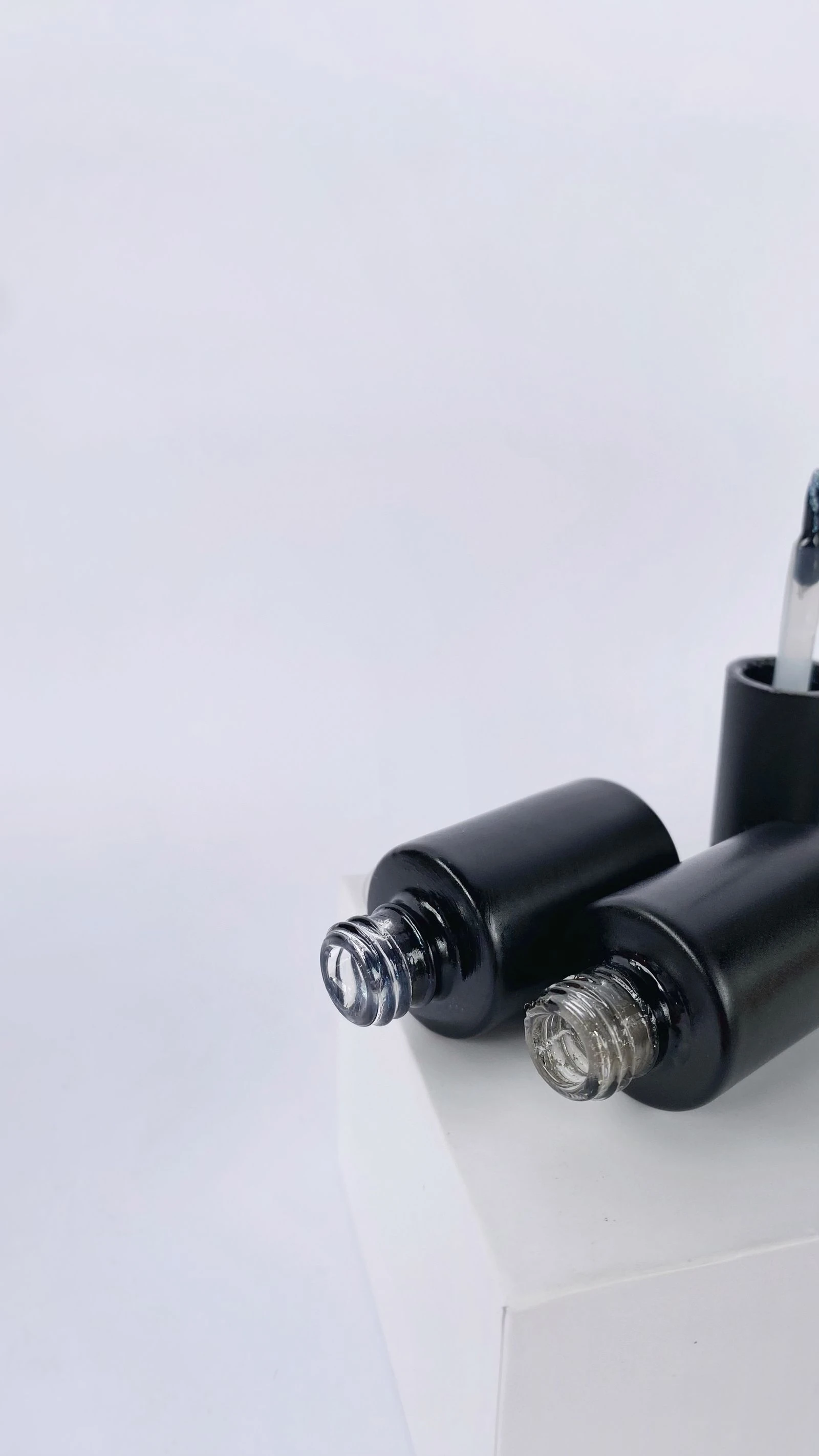
Adhesive tabs and nail glue: two ways to hold a press-on

Adhesive tabs and nail glue hold a press-on nail in different ways. A tab supplies a tacky adhesive layer that grips under pressure; the liquid cyanoacrylate in the compared brush-on glue hardens by polymerisation. This explains the material distinction, not a universal wear-time ranking. OPI and The Good Nail Co. position their own tabs as shorter-term and their glue as longer-wear options, but their figures are manufacturer or retailer claims, not NailWiki test results. [1][2][4][5][6]
KEY TAKEAWAYS
- Pressure-sensitive adhesives remain tacky and bond under light pressure. The OPI tab’s behaviour fits this definition, although OPI does not itself use the PSA term. [1][6]
- Cyanoacrylate hardens through rapid moisture-initiated polymerisation, a different mechanism from an already-tacky tab. [4]
- OPI lists Acrylates Copolymer for its tabs and Ethyl Cyanoacrylate with Polymethyl Methacrylate for its glue. Ingredient lines apply to the exact listings, not every market version. [1][2]
- Wear figures have different product scopes: OPI claims up to 14 days with its named press-on sets; The Good Nail Co. retailer lists 1–3 days for tabs and up to 2+ weeks with its glue. These are not matched test results. [1][2][5]
What an adhesive tab is: a layer that stays tacky
A pressure-sensitive adhesive (PSA) remains tacky and forms a bond when pressed against a surface. The NIST OSAC Lexicon gives this definition for a solvent-free viscoelastic material; an adhesives-industry column describes the same pressure-bonding behaviour. These are general adhesive definitions, not nail-product test results. [3][6]
OPI describes its Make It Stick Tabs as peel-and-stick adhesive tabs and lists Acrylates Copolymer. Their pressure-applied behaviour fits the general PSA definition. Calling the tab a PSA is therefore our interpretation of the description, not a chemistry classification supplied by OPI or a reconstruction of its full formulation. [1][6]
Because a tab is tacky as supplied, nothing has to set before the press-on is in place. OPI’s page lists “no dry time” as a benefit, which fits that behaviour, and its press-on guidance frames tabs as the choice for a single night and glue as the choice for longer wear. [1]
What nail glue is: a cyanoacrylate that sets in place
A 2018 review of cyanoacrylate chemistry describes these adhesives as stabilised liquids that harden rapidly when surface moisture initiates anionic polymerisation. In that reaction, small starting molecules link into polymer chains. The review concerns general adhesive chemistry and does not test OPI’s nail glue. [4]
OPI’s Make It Stick Glue lists Ethyl Cyanoacrylate and Polymethyl Methacrylate, and its page presents it as a brush-on press-on glue with a fast-drying formula. Ethyl cyanoacrylate is the ethyl member of the family the review describes, but the review concerns adhesives in general rather than nail products, and nothing in the sources consulted says what polymethyl methacrylate does in this particular glue. That role is left open rather than guessed. [2][4]
OPI uses fast-drying as everyday product wording. The chemistry review describes cyanoacrylate hardening as polymerisation. The distinction matters when explaining the material: a liquid that chemically sets is different from a tab whose adhesive layer is already tacky. [2][4]
Tab and glue compared as materials
The central difference is when the grip is created. A tab arrives with its grip already built in and needs pressure to engage it; a glue arrives as a liquid and forms its grip after it is applied. OPI’s everyday wording, no dry time for the tab and a fast-drying formula for the glue, describes that difference in product language. The table sets the OPI pages beside the kit page of a second brand, The Good Nail Co., as listed by the retailer MODELROCK. [1][2][3][4][5]
| Criterion | Adhesive tab | Brush-on glue |
|---|---|---|
| How the grip is made (OPI wording and trade definitions) [1][2][3][4][6] | Tacky as supplied; OPI lists no dry time as a benefit. The PSA class is an editorial inference from the trade definition. | Liquid that hardens after application; cyanoacrylates cure by moisture-initiated anionic polymerization; OPI calls the formula fast-drying. |
| Ingredients on the OPI pages [1][2] | Acrylates Copolymer | Ethyl Cyanoacrylate, Polymethyl Methacrylate |
| Ingredients on The Good Nail Co. kit page [5] | Polyethylene Terephthalate, Acrylates Copolymer | Ethyl Cyanoacrylate, Polymethyl Methacrylate |
| Wear wording (manufacturer claims) [1][2][5] | OPI: no wear time on the tabs page. The Good Nail Co.: 1-3 days. | OPI: up to 14 days with any OPI xPRESS/ON or On Point set. The Good Nail Co.: up to 2+ weeks with its Ultimate Bond nail glue. |
| How The Good Nail Co. kit page positions each [5] | As the temporary-wear option, applied to the natural nail. | As the long-wear option. |
Reading a wear claim without over-reading it
OPI’s glue page claims up to 14 days of wear with any OPI xPRESS/ON or On Point set, and OPI’s tab page states no wear time. The Good Nail Co. kit page gives 1-3 days for its tabs and up to 2+ weeks for its glue. None of these statements, as published on those pages, gives a test method, a number of wearers or a description of the nails involved, so they are marketing statements, and figures from two brands should not be ranked against each other. [1][2][5]
Hypothetical example: a reader compares a glue listing claiming up to 14 days with another claiming up to 2+ weeks. Those phrases alone cannot establish which holds longer for that reader. A useful comparison would need comparable conditions and a defined wear endpoint; neither product page supplies a matched comparison of the two glues. [5]
The comparison above covers labelled materials only. It does not say which option is safer, stronger or better for a particular nail, and it does not cover application, removal or skin reactions. Hazard and handling information for either product belongs in the manufacturer’s safety data sheet, and OPI’s pages link to a Safety Data portal. The trade column and the review are general adhesive literature, not nail-product tests, and product pages are market-specific, so the ingredient lines and wear claims quoted here should not be assumed for the same product sold elsewhere. [1][2][3][4]
Article Sources
- OPI (Wella Operations US LLC) - Make It Stick Tabs
Commercial source material
Product page “Make It Stick Tabs” (undated; copyright year only): description of glue-free adhesive tabs, Benefits list (including no dry time), the stick-on-nails guidance module contrasting a look for the night with a longer-lasting one, the Ingredients line “Acrylates Copolymer.” and the footer Safety Data link. The page states no wear time.
- OPI (Wella Operations US LLC) - Make It Stick Glue
Commercial source material
Product page “Make It Stick Glue” (undated; copyright year only): description of a brush-on press-on glue, Benefits list (up to 14 days of wear with any OPI xPRESS/ON or On Point set; fast-drying formula), the Ingredients line “Ethyl Cyanoacrylate, Polymethyl Methacrylate.” and the footer Safety Data link, which was not followed to a product-specific sheet.
- Adhesives & Sealants Industry (Adhesives Magazine) - Ask Dr. Dave: We are using pressure-sensitive adhesives; please explain tack, peel adhesion and shear strength.
Trade publication material
Column “Ask Dr. Dave” (1 October 2015): definition of pressure-sensitive adhesives as permanently tacky, the description of tack, the sentence on the balance between adhesive strength and cohesive strength, and the comparison of rubber-based and acrylic-based adhesives. The text does not define peel adhesion, shear strength or cohesive strength, shows no author, and does not mention nails or cosmetics.
Source date:
- Molecules 2018, 23(2), 465 (MDPI); authors Duffy, Zetterlund and Aldabbagh - Radical Polymerization of Alkyl 2-Cyanoacrylates
Expert reference material
Abstract; Section 1 Introduction (pp. 1-2) on short-chain cyanoacrylates in industrial and household super glues; Section 2.1 Anionic-type Polymerizations (p. 2) on curing from the thin film of surface moisture. First author’s affiliation on p. 1: Henkel Ireland Operations & Research Limited; Table 1 lists Loctite products. Pages 4 onward were not read.
Source date:
- MODELROCK (modelrocklashes.com), retailer page for The Good Nail Co. - THE GOOD NAIL CO. - Press-On Gel Nail Kit - 'NUDE GLAZE' - Medium Almond
Commercial source material
Retailer product page for The Good Nail Co. press-on gel nail kit: “Adhesive Tabs Ingredients”, “Nail Glue Ingredients”, the temporary-wear and long-wear application lines, and the sentences giving 1-3 days for tabs and up to 2+ weeks with the Ultimate Bond nail glue. The kit is described as gel press-on nails.
- NIST, OSAC Lexicon (reproducing ANSI/ASTM E1732 terminology) - Pressure-Sensitive Adhesive
Primary source
Definition below Pressure-Sensitive Adhesive: solvent-free viscoelastic material remains tacky and adheres to solid surfaces under slight pressure; date added 15 January 2025 is a lexicon addition date, not a nail-product test.
Products and resources
Our gel-tip department, with shape, pack-size and attachment information on individual listings. This is not evidence about press-on adhesive wear. NailMarket gel nail tips
Brand resource only; no A1/A2 technical, launch, testing or certification claim. BELOM equipment project