EPA air-cleaner guidance: document review
Document review
Viewed on 4 October 2026. Landing-page edition headings: August 2018; both PDF covers: July 2018. Webpage updated 3 August 2026.

The US EPA’s air-cleaner overview links residential consumer and technical guides. They help distinguish device categories and comparison metrics, but are not tests of manicure dust extractors. This document review follows the overview into those guides and records their different date labels. [1]
KEY TAKEAWAYS
Reviewed editions, dates and scope
The landing page labels the second-edition consumer guide and third-edition technical summary August 2018. Both PDF covers instead show July 2018: EPA-402-F-08-004 on the consumer guide and EPA 402-F-09-002 on the technical summary. These are distinct displayed labels, which we preserve. The landing page’s 3 August 2026 update is not a new edition of either PDF. [1][2][3]
The technical summary’s foreword explicitly limits its scope to residential air cleaners and excludes large or commercial structures. The overview distinguishes a portable cleaner for one room or area from central heating, ventilation and air-conditioning (HVAC) filters serving a home. These are the document’s categories; neither is automatically a local manicure-dust capture device. [1][2]
What CADR can and cannot compare
The consumer guide describes clean air delivery rate, or CADR, for particle removal and discusses smoke, dust and pollen ratings. Higher delivery rates relate to a larger residential room context; the rating is associated with the highest fan speed. Gas removal has no widely used equivalent rating system in the guide. [3]
Its filter discussion separates particle filtration from media designed for gases, such as activated carbon. For document comparison, this means “has a filter” is incomplete: the pollutant, test category and operating speed matter. A particle CADR should not be restated as solvent-vapour removal or dust capture at a technician’s hands. [3]
Filter efficiency is not whole-system effectiveness
The technical summary distinguishes the fraction removed from air passing through a cleaner from the reduction achieved in the room. Its filter discussion describes loading, pressure drop and bypass around filters. Those details explain why the filter medium’s performance is only part of an installed system’s result. [2]
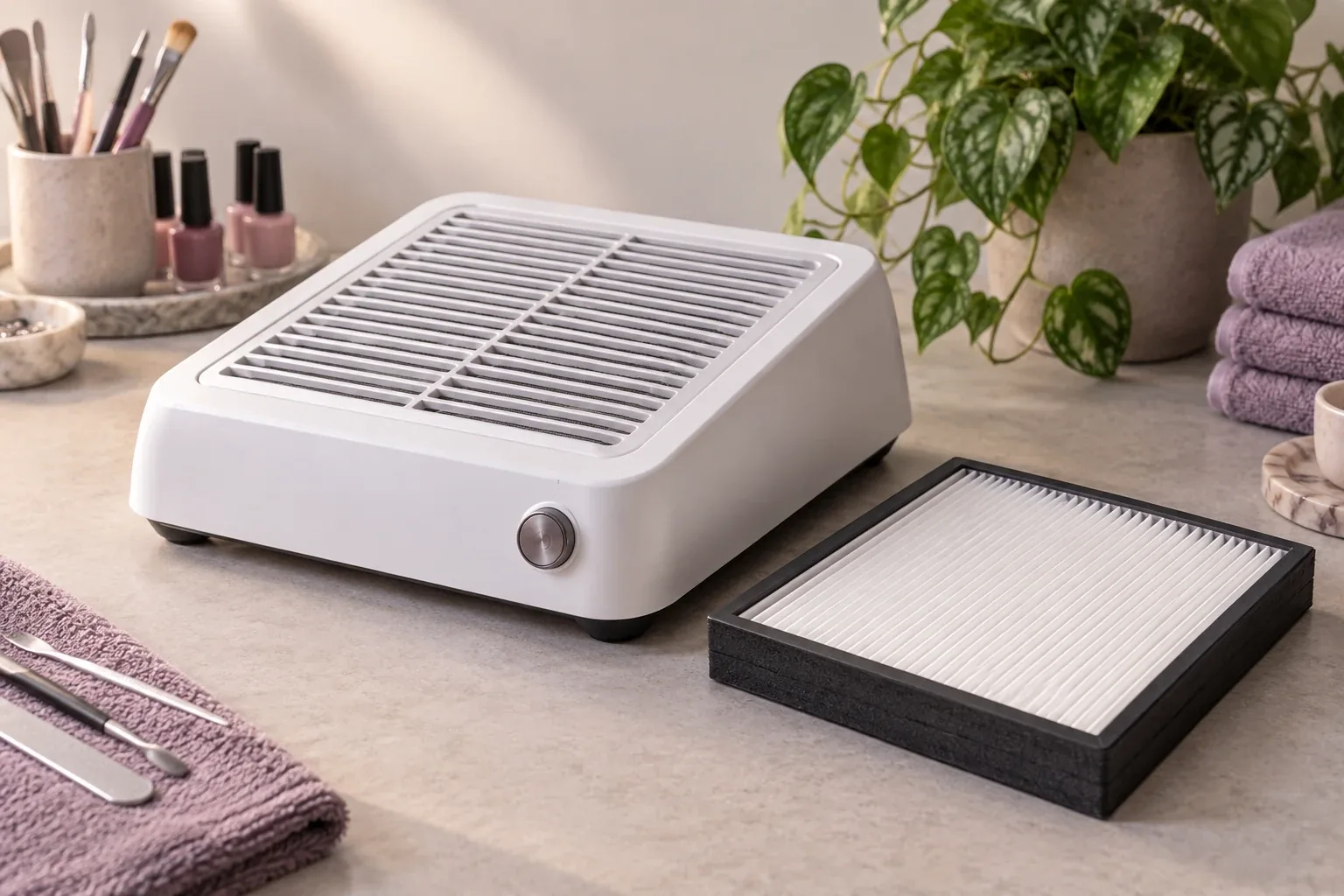
A useful device-data request would therefore distinguish filter test, complete-device airflow, operating speed, room context and any separately measured source-capture result. These are comparison questions, not a sizing calculation. NailWiki did not measure a device, design ventilation or estimate occupational exposure in this review.
What can transfer to a salon document review?
The transferable lesson is to separate source control, ventilation and supplementary filtration, and to read each performance claim against its pollutant and setup. The EPA overview says filtration cannot remove all pollutants. It does not present home air cleaning as proof that a named salon device captures particles before they enter surrounding air. [1]
The guides are useful vocabulary and metric references, within their stated residential scope. They do not establish CE status, workplace safety, a required manicure-extraction rate or any named device’s performance. Such claims need evidence for the exact device, intended use and test arrangement.
Article Sources
- US Environmental Protection Agency (EPA) — Air Cleaners and Air Filters in the Home
Primary source
Introduction: filtration supplements source control and ventilation; portable room cleaners are distinguished from central heating, ventilation and air-conditioning (HVAC) filters. Download headings label the consumer second edition and technical third edition August 2018. The footer records a webpage update, not a PDF edition date.
Webpage updated:
- US Environmental Protection Agency (EPA) — Residential Air Cleaners: A Technical Summary, third edition
Primary source
Cover: EPA 402-F-09-002, third edition. Printed page 2: residential scope; 7–8 and 33–34: CADR/cfm, efficiency × airflow, maximum-speed ratings and noise; 16: single-pass efficiency versus effectiveness in the occupied space; 19–20: fibrous media and particle-size metrics; 22–25: loading, resistance and bypass. Printed and one-based PDF page numbers match.
Date on PDF cover:
- US Environmental Protection Agency (EPA) — Guide to Air Cleaners in the Home, second edition
Primary source
Cover: EPA-402-F-08-004, second edition. Printed pages 3–5: particle CADR, gas filtration and filter choice; page 5: highest-speed ratings and smoke/dust/pollen categories; page 6: fan-speed-dependent noise. Residential room-air guidance, not a workstation capture test.
Date on PDF cover:
Written and reviewed with AI assistance using the linked sources. No hands-on product testing or independent specialist review was performed.