Pattern scale and repetition: why the same motif looks different

Pattern scale describes the size of a motif relative to its surrounding area. Repetition describes its recurrence. In a nail design, motif size, spacing and number of repeats are distinct decisions; changing one can alter the composition. [1]
KEY TAKEAWAYS
Size relative to the surface
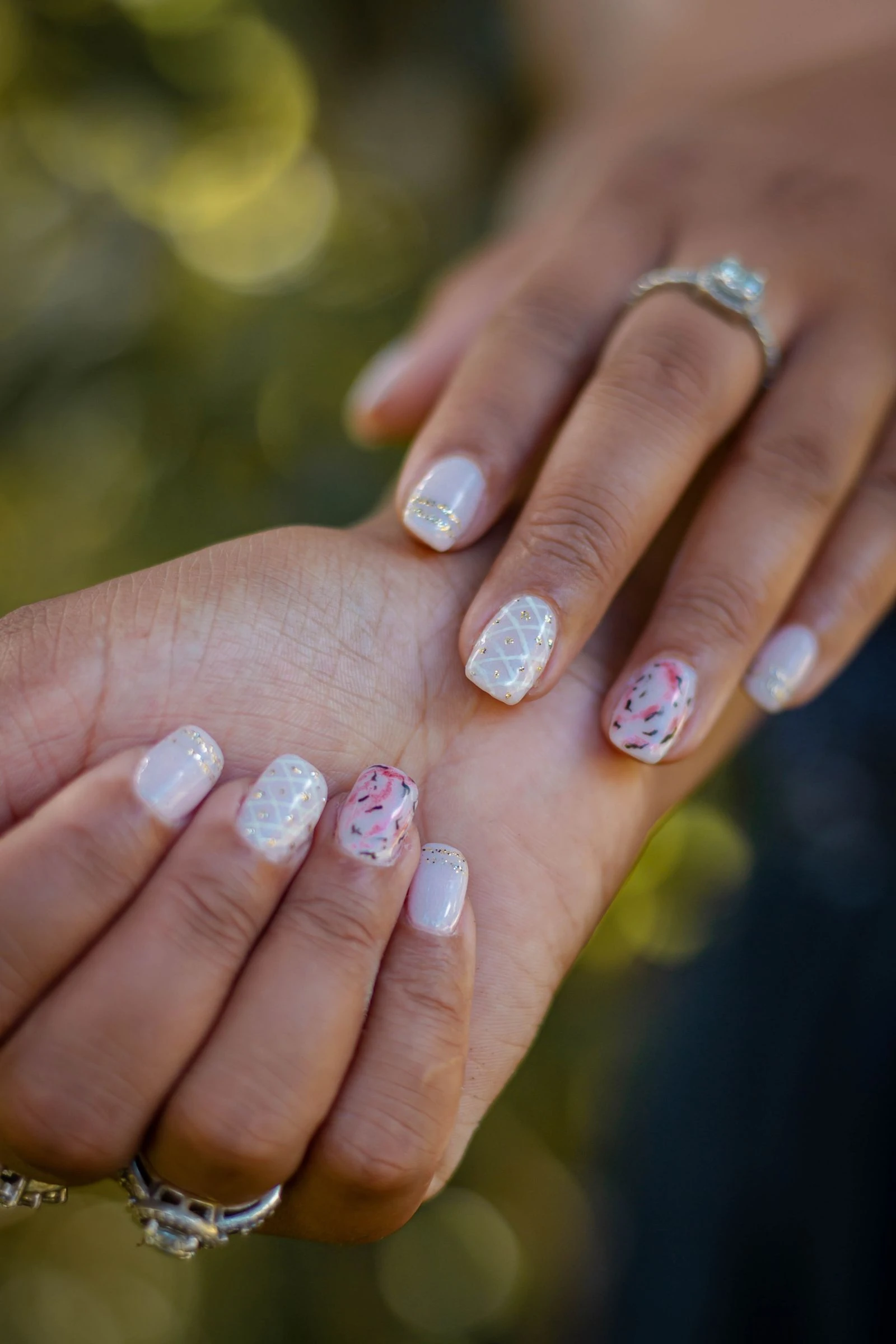
Scale compares the motif’s size with the area around it; repetition means that an element recurs. Adobe treats scale/proportion and repetition/pattern as separate design principles. Applied to an illustrative nail outline, one leaf nearly filling the width becomes a dominant accent, while a much smaller leaf leaves more visible background. Enlarging the leaf without changing the outline also leaves less room for neighbouring motifs. [1]
Spacing versus quantity
The same number of motifs can sit close together or far apart. Count and spacing should have separate fields. Repeating a colour across a set is also different from repeating an identical shape on every nail.
Use matched outlines to compare scale
For a proposed paper comparison, use the same nail outline for each option and change just one field: motif size, count or spacing. A large single leaf and several small leaves vary both size and count; they do not isolate scale. Keep the image crop and outline unchanged, then note which field differs and how much background remains.
Article Sources
- Adobe - Understanding the Basic Principles of Graphic Design
Educational reference material
White Space or Negative Space: separation and emphasis; Scale and Proportion: relative element sizes; Emphasis and Hierarchy: visual priority; Repetition and Pattern: repeated elements. General graphic-design principles, not nail-product or clinical evidence.
Article date:
Products and resources
Professional nail materials and tools with NailMarket.eu